


Organizational Change
Your Strategy Is Fine. Your Execution System Isn't.
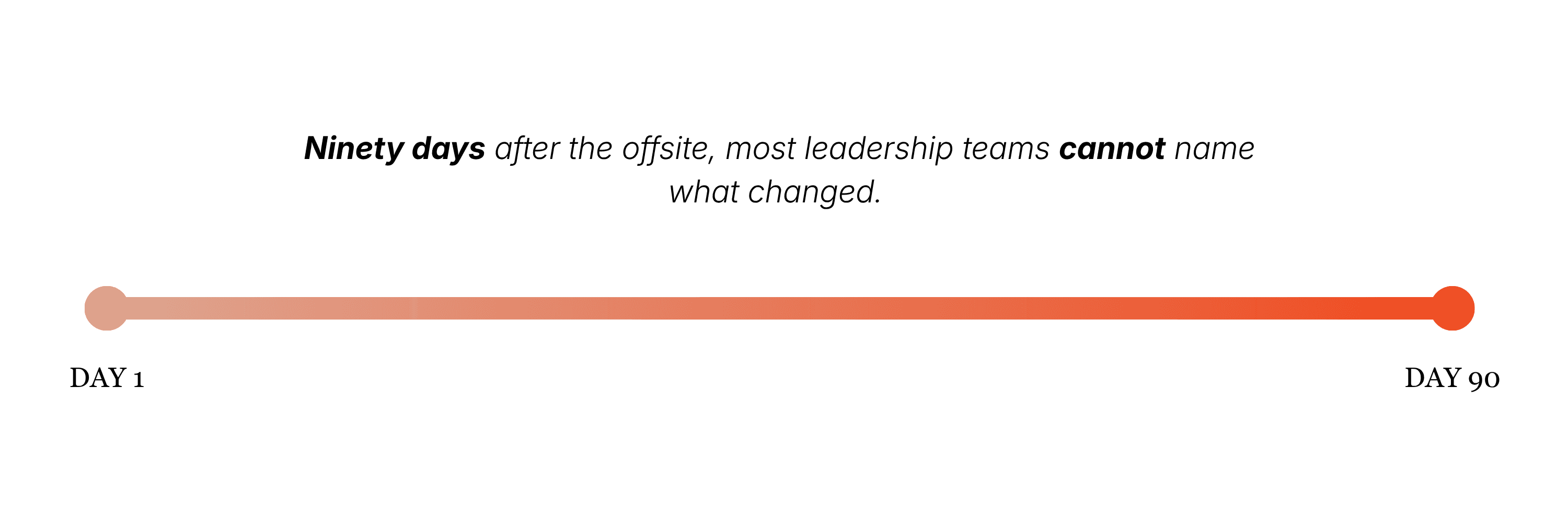
Ninety days after the offsite, most leadership teams cannot name what changed. That is a finding, not a failure of memory.
Ninety days after the strategy session, ask your leadership team three questions.
What decision got made faster than it would have a year ago?
What did we stop doing?
What number does this team now watch together that it did not watch before?
If the answers are thin, resist the first conclusion. The strategy is probably not the problem.
The strategy is the visible artifact
When execution disappoints, the strategy gets reopened. It is the thing everyone can see. There is a document. There was a session. There are slides with someone's name on them.
The system that connects strategy to coordinated execution has no document. It does not appear on the org chart. Nobody owns it. So when it fails, it fails invisibly, and the diagnosis lands on whatever is visible instead — the plan, the people, or the culture.
Most organizations I work with do not have a strategy problem. They have an execution system problem.
What actually breaks
The signs are usually visible:
Priorities compete. The deck says three; the business runs fifteen.
Decisions stall, escalate, or get made twice.
Functions hit their numbers while the enterprise misses.
Meetings and metrics explain performance but do not drive decisions.
Cross-functional issues persist because ownership and follow-through are unclear.
These are not effort failures. They are signs that the system connecting strategy to execution is not doing its job.
Why the standard response makes it worse
When execution weakens, capable leaders respond the way capable leaders do. They add.
More meetings. More follow-up. More executive check-ins. Another scorecard. Faster escalation. Direct intervention on the accounts that matter most.
Each response is individually reasonable. Together they produce short-term movement, and then the same issues return, now inside a heavier calendar and a more tired leadership team.
The reason is straightforward. These are effort responses to a design problem, and effort was never the constraint. Your leaders are already working hard. Adding load to people who are already at capacity does not create capacity. It creates fatigue and a temporary impression of control.
Execution problems are not effort problems. They are system-design problems.
Growth is what exposes it
Informal operating practices work well at a certain size. When twelve people can resolve most things in a hallway, you do not need defined decision authority. When one leader can hold the entire picture in their head, you do not need a shared enterprise view of performance.
Growth removes those conditions faster than most teams notice. More people, more functions, more products, more channels, more dependencies, more consequential decisions per week. The number of ways an enterprise can misalign rises much faster than headcount does.
The practices that got you here stop working quietly. Because they degrade gradually rather than failing outright, nobody names the moment. The team simply works harder to hold the same level of performance — and reads that additional effort as commitment rather than as a signal.
What to do this week
Run the three-question test yourself, in writing, before you run it with your team. Written answers are harder to talk past than spoken ones.
Then extend it. Take the six most consequential decisions your business made last quarter. For each one, write down who owned it, how long it took from first surfacing to settled, and whether it was reopened afterward.
You are not evaluating decision quality. You are examining the process that produced the decision.
Most executives find one of three things. The same name appears repeatedly as owner, usually theirs. Or no clear owner can be identified for several of them. Or the elapsed time is materially longer than anyone on the team would have guessed.
None of those is a leadership capability finding. Each is a design finding — and design is the thing you can change.
The distinction that matters
A strategy problem means you chose the wrong direction.
An execution system problem means the direction is sound and the organization cannot reliably act on it.
The second is far more common in mid-market and lower-enterprise organizations — companies between $100 million and $1 billion in revenue — and it is routinely misdiagnosed as the first. Teams rework a strategy that was never broken, hold another offsite, and then wonder why the next ninety days resemble the last ninety.
Alignment is not the finish line. Execution is.
Roger Young works with executive teams on the systems that connect strategy to execution. Excel Leadership Group.
MORE IN THIS CATEGORY


