


Organizational Change
You Have Three Priorities. You're Running Nineteen.
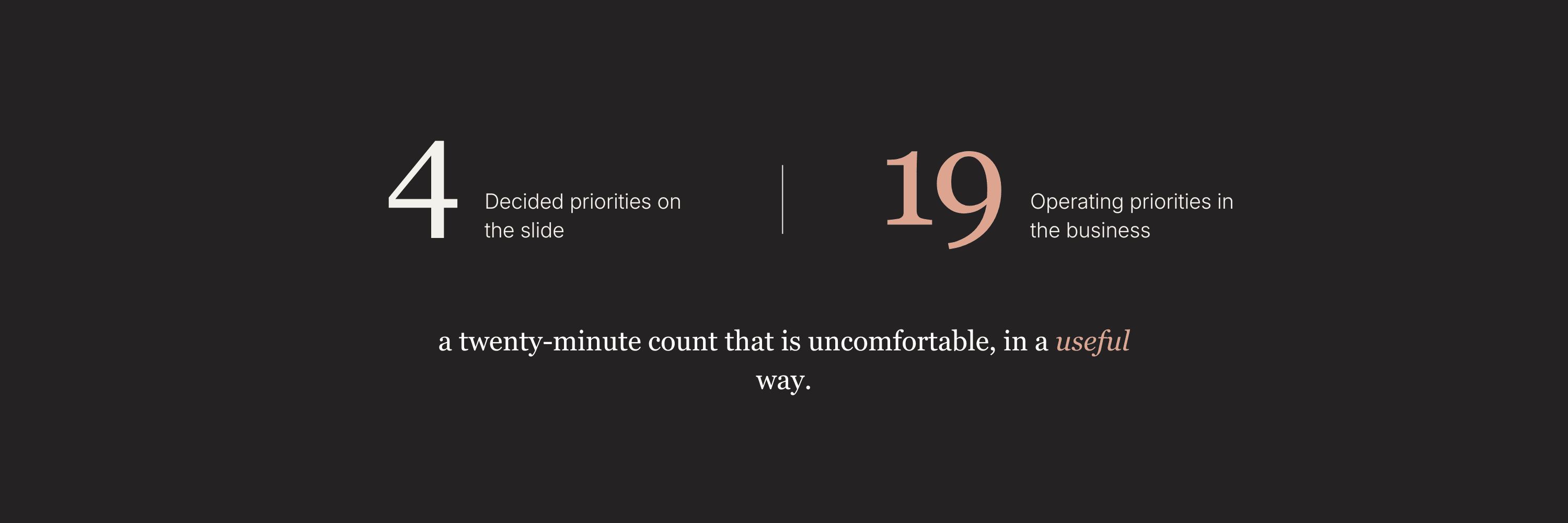
A twenty-minute counting exercise that is uncomfortable in a useful way.
Open your most recent quarterly leadership deck. Write down the stated enterprise priorities. Most teams have three to five.
Now open three other things: the project list, the budget, and your own calendar for the past month. Count what is actually funded, staffed, and receiving leadership attention.
The first number is what you decided. The second is what you are running.
The gap between them is your prioritization discipline, measured precisely, with nobody's opinion involved.
Addition without subtraction
The list is not the failure. The list is the symptom. The failure is that nothing was ever removed.
Watch how the portfolio grows. A customer escalation becomes a workstream. A board question becomes an initiative. A competitor move becomes a project. A new executive arrives with a mandate and brings three more.
Every one of those additions is individually defensible. None of them replaced anything.
After six quarters of that, the stated priorities are still three, because nobody updated the slide. The operating reality is nineteen, because nobody counted.
A priority list that only grows is not a set of choices. It is an accumulation.
The trade-offs get made anyway
Here is the part that gets missed. Declining to prioritize does not mean the trade-offs go unmade. It means they get made further down the organization and out of the leadership team's sight.
When nineteen things carry equal official standing, the sequencing decision moves to whoever holds the constrained resource. It gets made by capacity, by urgency, and by volume — the loudest customer, the most persistent executive, the deadline closest to today.
That is a functioning prioritization system. It is running in your business right now. It just is not the one your leadership team designed, and it optimizes for immediacy rather than enterprise consequence.
The choice is not whether trade-offs get made. The choice is whether leaders make them deliberately or the calendar makes them by default.
Four tests
Something is functioning as an enterprise priority only if it changes four things.
Where money and people go. If resource allocation did not move when the priority was set, the priority is decorative.
What gets leadership attention. Review the last month of executive forums. If a stated priority consumed no meaningful time, it is not operating as one.
What gets measured. A priority with no enterprise measure attached cannot be managed. It can only be discussed.
What you decline. This is the hardest and the most diagnostic of the four. If naming the priority did not cause the organization to stop, delay, or refuse something, then no prioritization occurred — a label was applied.
Something that fails all four is not a priority. It is a preference.
The reasonable objection
The pushback I hear most is that a complex business genuinely has more than three things that matter. That is true, and the answer is not to pretend otherwise.
But importance is the wrong filter. Nearly everything on a nineteen-item list is important — that is precisely why each item survived. Importance cannot discriminate.
The useful filter is enterprise consequence and sequence. Which of these, if it does not move in the next two quarters, materially limits enterprise performance? And what has to be true first?
Three is a working constraint rather than a rule, and it should be treated that way. A simpler business may operate well on one or two. A genuinely complex enterprise may warrant a fourth. What should not happen is adding a priority in order to avoid a conversation about what matters more.
Writing down what stops
The practical output is short and awkward to produce.
For each enterprise priority: what it is, why it matters to the business, what outcome it produces, how success is measured, and the line most teams skip — what the organization will stop, delay, or deliberately do less well in order to fund it.
That last line is where prioritization becomes real. Until a leadership team can say out loud what it is choosing not to do, and can name who is affected by that choice, it has produced a list rather than a decision.
Everything cannot remain important. Executives know this already. The discipline is not in knowing it.
It is in saying it in a room where someone's project is the thing being deprioritized — and then holding that position ninety days later when the pressure arrives.
That discomfort is not a sign the process is going badly. It is the process working.
Roger Young works with executive teams on the systems that connect strategy to execution. Excel Leadership Group.
MORE IN THIS CATEGORY


